A few more things about the Gravity and Portals post...
One of the What-If.xkcd.com answers recently concerned airflow through portals. According to Randall's answer, the flow rate through portals in Mexico City and Boston would be about 440 mph.
The same thing would happen with our world-folding portals, assuming that you moved the air along with everything else. Maybe there are transparent walls on the "front" and "back" of our world in the fourth dimension?
[Stupid diagrams! Upload!]
This seems like it would pose a problem, if we had a very (very very) tall room.
But remember, we would still have to fold it. That takes quite a bit of energy, which is proportional to the square of the height (remember, Wnet = F Δx = mworld g Δx, and the mass of part of a uniformly-dense world would be proportional to the volume we lift).
We're already using a LOT of energy in our folding, so let's assume the mass-to-energy-converter in our portal gun can't quite lift enough of the world to make a significant difference in air pressure. Portals on the moon are right out.
Tuesday, October 23, 2012

Thursday, October 18, 2012
Gravity and Portals
As you might be able to guess, I've been playing quite a bit of Portal 2 recently.
If you haven't played it, it's a physics-puzzle-based game where you have the ability to create portals on certain surfaces.
These portals act quite a bit like the ones I mentioned in my earlier post, where you could "fold" the two-dimensional world.
 But the problem with the portals in the game is that they break the Laws of Thermodynamics. These are a set of rules about how energy works, which can be reduced to this:
So what happens if you have portals to work with?
You can create energy by teleporting up to a ledge, which gives you more gravitational potential energy. Normally you would have to convert kinetic (motion) energy in order to get up there, which makes up for it. But if you can teleport, then that restriction is gone!
And you can also destroy energy, which should also be impossible. Say you step on a Faith Plate, a catapult-like thing that launches you upwards. The catapult converts potential energy from its battery or power source into kinetic energy, which it then imparts on you. That all works. Let's say you land on a ledge at the top. When you hit the ledge, your energy is transferred to it. Still following the laws.
But what if you place a portal underneath you at the top? Now you're at the bottom again...but where did all the potential energy go? It's just gone!
[Images Pending, Sorry]
But wait a minute.
The third law says that there's no way to break either of the first two. Did we just get around that? Is our test subject freezing to death in a room colder than outer space?
It makes more sense if you look at a two-dimensional Flatlander doing the same thing. Let's turn Flatland on its edge, so that we can see the effects of gravity.
Now, when we make our first portal up to the ledge, what happens?
There's our answer! We didn't actually gain potential energy at all--because when the portal is open, the two places are at exactly the same height!
When we created the portal, we actually lifted up the lower part of the universe, and that's where the energy came from.
And, if our Flatlander jumps off the ledge to use some of that energy, then gravity starts acting strangely...when they're in the "folded" part, there seems to be no gravity at all. That's not what we see in Portal 2, although it might be interesting if we did.
Now, when we close the portal, we open out the universe again, and everything goes back to normal.
So what about the second example? Can we still destroy energy?
As it turns out, no. Let's say we open the portal when our little test subject is at the peak of their trajectory, about to land.
[Images Pending, Sorry]
Since we lifted up half of their world, they didn't lose any energy. Hitting the ground below was the same as if they hadn't used a portal at all.
But when we CLOSE the portal, and set everything back to normal, then there's a release of energy. And since we set down a little bit more than we lifted up (since the Flatlander wasn't in the area we folded the first time), that's where the extra energy goes.
So that makes sense now, although gravity still behaves strangely around portals.
If the test subject jumps off a high platform, hopefully above something soft, then what happens when we open a portal?
To us it looks like they fall straight down, but to them gravity has suddenly broken. I've used a bit of hacking to show what it would look like in the video game itself. (This also shows the examples I was talking about.)
Strange, no? I can see why Valve didn't build their game this way. Maybe that portal gun contains a nuclear battery or some other small power source, which can not only provide enough power to fold the universe but which can change the effects of gravity (look at the effect when you hold a cube).
If you haven't played it, it's a physics-puzzle-based game where you have the ability to create portals on certain surfaces.
These portals act quite a bit like the ones I mentioned in my earlier post, where you could "fold" the two-dimensional world.

- You can't get out more than you put in--there's no way to create or destroy energy.
- You can't even get back just what you put in--a little bit spreads out into the universe. More subtly, some things are irreversible. If a perpetual motion machine fails because friction keeps turning some energy into heat, you can't put it in a box and extract that heat again in a useful way.
- You can't break either of the first two rules. Ever. Under any circumstances. The only way you could do it would be to lower a perfect crystal to absolute zero, and this law says that's impossible*.
So what happens if you have portals to work with?
You can create energy by teleporting up to a ledge, which gives you more gravitational potential energy. Normally you would have to convert kinetic (motion) energy in order to get up there, which makes up for it. But if you can teleport, then that restriction is gone!
And you can also destroy energy, which should also be impossible. Say you step on a Faith Plate, a catapult-like thing that launches you upwards. The catapult converts potential energy from its battery or power source into kinetic energy, which it then imparts on you. That all works. Let's say you land on a ledge at the top. When you hit the ledge, your energy is transferred to it. Still following the laws.
But what if you place a portal underneath you at the top? Now you're at the bottom again...but where did all the potential energy go? It's just gone!
[Images Pending, Sorry]
But wait a minute.
The third law says that there's no way to break either of the first two. Did we just get around that? Is our test subject freezing to death in a room colder than outer space?
It makes more sense if you look at a two-dimensional Flatlander doing the same thing. Let's turn Flatland on its edge, so that we can see the effects of gravity.
Now, when we make our first portal up to the ledge, what happens?
There's our answer! We didn't actually gain potential energy at all--because when the portal is open, the two places are at exactly the same height!
When we created the portal, we actually lifted up the lower part of the universe, and that's where the energy came from.
And, if our Flatlander jumps off the ledge to use some of that energy, then gravity starts acting strangely...when they're in the "folded" part, there seems to be no gravity at all. That's not what we see in Portal 2, although it might be interesting if we did.
Now, when we close the portal, we open out the universe again, and everything goes back to normal.
So what about the second example? Can we still destroy energy?
As it turns out, no. Let's say we open the portal when our little test subject is at the peak of their trajectory, about to land.
[Images Pending, Sorry]
Since we lifted up half of their world, they didn't lose any energy. Hitting the ground below was the same as if they hadn't used a portal at all.
But when we CLOSE the portal, and set everything back to normal, then there's a release of energy. And since we set down a little bit more than we lifted up (since the Flatlander wasn't in the area we folded the first time), that's where the extra energy goes.
So that makes sense now, although gravity still behaves strangely around portals.
If the test subject jumps off a high platform, hopefully above something soft, then what happens when we open a portal?
 |
| Left: what we 3-dimensional beings can see. Right: What it looks like to a test subject. |
To us it looks like they fall straight down, but to them gravity has suddenly broken. I've used a bit of hacking to show what it would look like in the video game itself. (This also shows the examples I was talking about.)
Strange, no? I can see why Valve didn't build their game this way. Maybe that portal gun contains a nuclear battery or some other small power source, which can not only provide enough power to fold the universe but which can change the effects of gravity (look at the effect when you hold a cube).
Thursday, October 4, 2012
One-Point Perspective
People seemed to like my first post about the fourth dimension, so I'm going to attempt to write another. This one gave me a migraine when I first started thinking about it, so be warned.
As you might remember from geometry classes, there are five "Platonic Solids" in three dimensions. These are objects that are made up of a single two-dimensional polygon, repeated and connected. In math terms, they're the tetrahedron, the cube, the octahedron, the dodecahedron, and the icosahedron. In geek terms, they're the d4, the d6, the d8, the d12, and the d20. They're named after Plato, who believed that the four elements of the universe were made up of little pieces, shaped like these solids. Water was the icosahedron, which is almost spherical and can roll around. Fire was the tetrahedron, which has sharp corners and is only stable with a point facing upwards. Earth was the cube, which can be packed together into bigger cubes without space between them. And air was the octahedron, for no real reason. (The dodecahedron was left out of this theory. It's now best known as the D&D die that nobody ever uses, the d12.)
If you think about it, these could be considered the 3-dimensional equivalents to regular polygons--shapes where every edge is the same length, such as a square or an equilateral triangle. So could there be four-dimensional equivalents, built out of 3-dimensional solids?
The easiest one to think about is the cube, so I'll just focus on that one for now.
The cube can be thought of as part of a series, going up through dimensions: in one dimension there's the line segment, in two dimensions the square, in three the cube, and...so on? The four-dimensional one is sometimes called the 4-hypercube, or tesseract.
Now, if you start from the one-dimensional line segment, you can form a square by duplicating the segment, then connecting them. So if we start with a one-inch line segment pointing forward-backward, we can place another segment an inch to the right, and connect the endpoints.
That gets a square. And we can repeat the process to make a cube: place another square an inch above the first, and connect the endpoints.

To make a tesseract, then, it would seem that you could just place another cube one inch along the fourth dimension, and connect the lines. That makes theoretical sense...but what would it look like, if you actually created one? To figure that out, we can turn to perspective.
Generally perspective is used to portray a three-dimensional object in two dimensions, by stretching and skewing parts of it.
If we took a folded paper cube, made of six squares, we could show it to a Flatland being by placing the six squares next to each other--"unfolding" it into a cross shape.
And we can do the same for the eight cubes of the tesseract.
Salvador Dali once made a painting based on this net.
But this picture doesn't help us very much. I, for one, can't really tell anything about what the finished tesseract would look like from seeing the arrangement of cubes there, even though I can see what shapes comprise it.
So the other way to show it to the Flatlanders would be to use perspective.

If you look at the picture, you can imagine the cubes being there, although of course it's two-dimensional. But if you tell the Flatlanders that each cube made of six squares, they will probably be very confused. Looking at the picture, one can see six rhombuses, but only two actual squares (the front and back). The other four are distorted by the perspective. And if you somehow animated your drawing to make the cube rotate, it would blow their minds. Somehow these squares are becoming rhombuses, and passing through each other, and even changing in size! But somehow this is supposed to be a solid object?
It might be easiest to draw the cube with perspective using one-point perspective, where every line leads to a single vanishing point. [The cube on the right.]
You can still see that this is a cube, although it's less clear than some other ways of drawing it.
I was thinking a few days ago that this form of perspective could also possibly be applied to a four-dimensional object. One-point perspective is probably the easiest to make. But somehow it will need to be applied to a three-dimensional object...
Looking at the cube, it looks like a smaller square inside a bigger square, with diagonal lines representing the third dimension.
So, why not try that with our tesseract?
Unfortunately, I can only upload two-dimensional pictures onto this blog, but here's a photo of my model.
We could also put the vanishing point off-center, so that the squares or cubes aren't inside each other. That also looks weird, but different.
So I don't know if there really is a "best way" to show four-dimensional shapes. I personally like the perspective models better.
Animation can help, also, by letting us see how it looks as it rotates. Sadly, I don't have a way to project animation into three dimensions, so it will have to be on a screen or a page. It's good that our brains are tuned to see two-dimensional pictures as three-dimensional.
So here's our tesseract, rotating.
Now you can tell how those poor Flatlanders felt when they saw the rotating cube turn itself inside out.
And, just because I haven't screwed with your minds enough yet, here are the four-dimensional versions of the D&D dice. (You can also see the view from inside the "4d120".)
Enjoy! >: D
As you might remember from geometry classes, there are five "Platonic Solids" in three dimensions. These are objects that are made up of a single two-dimensional polygon, repeated and connected. In math terms, they're the tetrahedron, the cube, the octahedron, the dodecahedron, and the icosahedron. In geek terms, they're the d4, the d6, the d8, the d12, and the d20. They're named after Plato, who believed that the four elements of the universe were made up of little pieces, shaped like these solids. Water was the icosahedron, which is almost spherical and can roll around. Fire was the tetrahedron, which has sharp corners and is only stable with a point facing upwards. Earth was the cube, which can be packed together into bigger cubes without space between them. And air was the octahedron, for no real reason. (The dodecahedron was left out of this theory. It's now best known as the D&D die that nobody ever uses, the d12.)
If you think about it, these could be considered the 3-dimensional equivalents to regular polygons--shapes where every edge is the same length, such as a square or an equilateral triangle. So could there be four-dimensional equivalents, built out of 3-dimensional solids?
The easiest one to think about is the cube, so I'll just focus on that one for now.
The cube can be thought of as part of a series, going up through dimensions: in one dimension there's the line segment, in two dimensions the square, in three the cube, and...so on? The four-dimensional one is sometimes called the 4-hypercube, or tesseract.
Now, if you start from the one-dimensional line segment, you can form a square by duplicating the segment, then connecting them. So if we start with a one-inch line segment pointing forward-backward, we can place another segment an inch to the right, and connect the endpoints.
That gets a square. And we can repeat the process to make a cube: place another square an inch above the first, and connect the endpoints.

To make a tesseract, then, it would seem that you could just place another cube one inch along the fourth dimension, and connect the lines. That makes theoretical sense...but what would it look like, if you actually created one? To figure that out, we can turn to perspective.
Generally perspective is used to portray a three-dimensional object in two dimensions, by stretching and skewing parts of it.
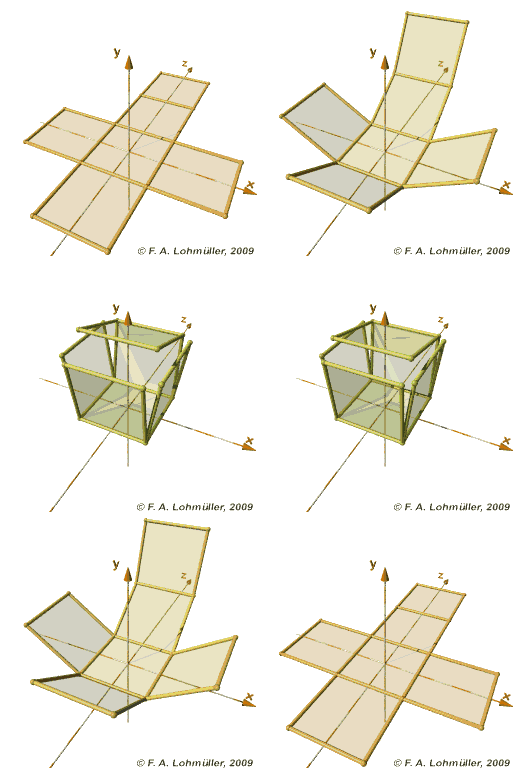
If we took a folded paper cube, made of six squares, we could show it to a Flatland being by placing the six squares next to each other--"unfolding" it into a cross shape.
 |
| I didn't make this image, I'm bad at 3d animation. |
And we can do the same for the eight cubes of the tesseract.
 |
| Nor this one, sorry. |
Salvador Dali once made a painting based on this net.
But this picture doesn't help us very much. I, for one, can't really tell anything about what the finished tesseract would look like from seeing the arrangement of cubes there, even though I can see what shapes comprise it.
So the other way to show it to the Flatlanders would be to use perspective.

If you look at the picture, you can imagine the cubes being there, although of course it's two-dimensional. But if you tell the Flatlanders that each cube made of six squares, they will probably be very confused. Looking at the picture, one can see six rhombuses, but only two actual squares (the front and back). The other four are distorted by the perspective. And if you somehow animated your drawing to make the cube rotate, it would blow their minds. Somehow these squares are becoming rhombuses, and passing through each other, and even changing in size! But somehow this is supposed to be a solid object?
 |
| If it doesn't rotate, click it. Note: I didn't make this! |
It might be easiest to draw the cube with perspective using one-point perspective, where every line leads to a single vanishing point. [The cube on the right.]
You can still see that this is a cube, although it's less clear than some other ways of drawing it.
I was thinking a few days ago that this form of perspective could also possibly be applied to a four-dimensional object. One-point perspective is probably the easiest to make. But somehow it will need to be applied to a three-dimensional object...
Looking at the cube, it looks like a smaller square inside a bigger square, with diagonal lines representing the third dimension.
So, why not try that with our tesseract?
Unfortunately, I can only upload two-dimensional pictures onto this blog, but here's a photo of my model.
 |
| Here's my simple model. The vanishing point is at the very center. |
We could also put the vanishing point off-center, so that the squares or cubes aren't inside each other. That also looks weird, but different.
 |
| The lines go through the cube for clarity. The vanishing point is off to the right. |
So I don't know if there really is a "best way" to show four-dimensional shapes. I personally like the perspective models better.
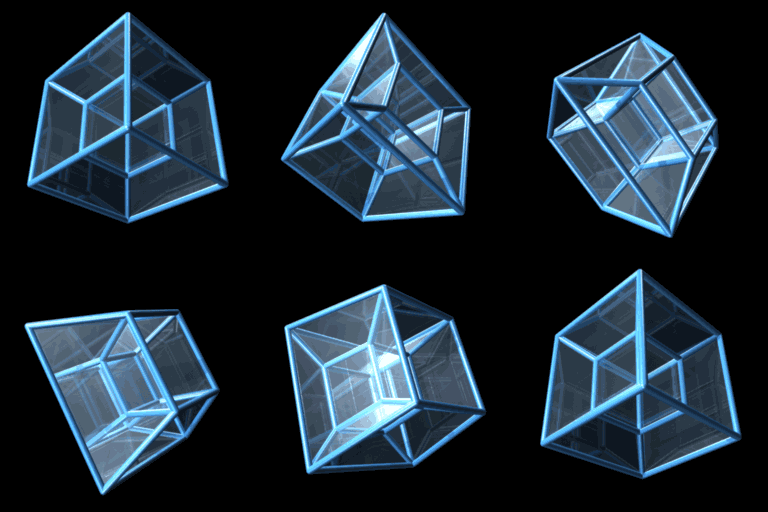
Animation can help, also, by letting us see how it looks as it rotates. Sadly, I don't have a way to project animation into three dimensions, so it will have to be on a screen or a page. It's good that our brains are tuned to see two-dimensional pictures as three-dimensional.
So here's our tesseract, rotating.
 |
| Made by Jason Hise, released into the public domain. |
And, just because I haven't screwed with your minds enough yet, here are the four-dimensional versions of the D&D dice. (You can also see the view from inside the "4d120".)
Enjoy! >: D
Wednesday, September 19, 2012
Script Evolution, Part 0
This is just going to be a short post, about an idea that I had had recently.
As I've probably said before, I've always been interested in different writing systems. So as soon as I saw the "tengwar" script on the cover of the Fellowship of the Ring, I started looking for more information on it.
I discovered that Tolkein, as a perfectionist, wanted his writing systems to seem as real as possible. He had created a "base" script for the tengwar, and slowly evolved it into the modern version, imitating the way that real forms of writing change over time. I thought this sounded like a very interesting idea, and I wanted to try it as an experiment.
So here's a simple idea for a writing system that I came up with recently. The letters are simple geometric shapes, and they're arranged into syllables as in Hangul (the Korean alphabet).
Every couple weeks I will try to write something out over and over in the script. Certain features should hopefully start to change over time.
So here's the script as it starts out.

I tried to make it straight and angular, as the Latin alphabet originally was (to make it easier to carve into stone, mostly). The vowels O and U were added to the fictional language later, and have more rounded shapes. And the shapes will probably become more rounded through their "evolution", just as A became a and M became m for us.
The alphabet is phonetic, so it doesn't quite match the English alphabet. Most of the letters are pronounced just as you'd expect, except:
- ʔ - the "glottal stop" that occasionally replaces the "t" sound in "button", uncommon. Many "t"s are replaced by this letter in Australian and Cockney dialects.
- Ŋ (next to N and M, if it doesn't show up) - the "ng" sound in the word "singing"
- Þ - the "th" sound in the word "thin", which looked like a "y" in Old English (thus "ye olde...", which is supposed to be "the")
- Ð - the "th" sound in the word "this", slightly different from Þ. Compare ether (using Þ) and either (using Ð)
- X - the "ch" in many German and Scottish words, such as loch. In German, this can be used for both the ich-Laut and the ach-Laut sounds.
- ʃ - not an integral (∫), this is the "sh" sound in "shine"
- ʒ - sometimes spelled "zh", the si sound in "vision" and the s in "measure"
- Y - Used as a vowel here, not a consonant. It doesn't actually appear in English, but has a letter in several other languages: ü in German, u in French, and υ in Classical Greek. Close to the vowel in "seen".
In this script, those groups are arranged into blocks. The initial block is in the top left, the vowels in the top right, and the final block along the bottom. (See the diagram).

As a final thought, here are the first two lines of a poem by a well-known author. I've used the letter "i" for consonantal y when necessary, and the rest of the vowels are exactly as in the original poem.

Wednesday, September 5, 2012
Shapeshifting and the Fourth Dimension
Earlier in the summer, I was talking (well, emailing) with one of my friends about a possible scientific explanation for lycanthropy or shapeshifting, using a fourth spatial dimension.
As you probably know, the world we live in already has four dimensions - 0 is time, 1 is forwards-backwards, 2 is left-right, and 3 is up-down. (I'm going to ignore time from now on, since I'm talking specifically about spatial dimensions.)
However, there's been research done on additional dimensions, with string theory saying that there might be nine or more. Obviously we can't see any more dimensions, but people have come up with metaphors for explaining this. One of the most famous is the book "Flatland", narrated by a square living in a supposedly two-dimensional universe. People are polygons, the higher classes having more sides, and buildings are made of several line segments in a pattern.
When a three-dimensional person comes to the narrator's house, he's able to use that additional dimension to move through walls by stepping over them, and can become "invisible" by just being above the world, or somehow seal a door shut by putting a nail through from top to bottom.
 He can even create "portals" for them, by literally folding the world and pushing them through what's now empty space. This was one explanation for how neutrinos seemed to move faster than light - they moved at their normal speed, but took a "shortcut" through a higher dimension.
A four-dimensional being would theoretically be able to do the same things in our world as we could in Flatland. However, there are other interesting ways that the fourth dimension could apply.
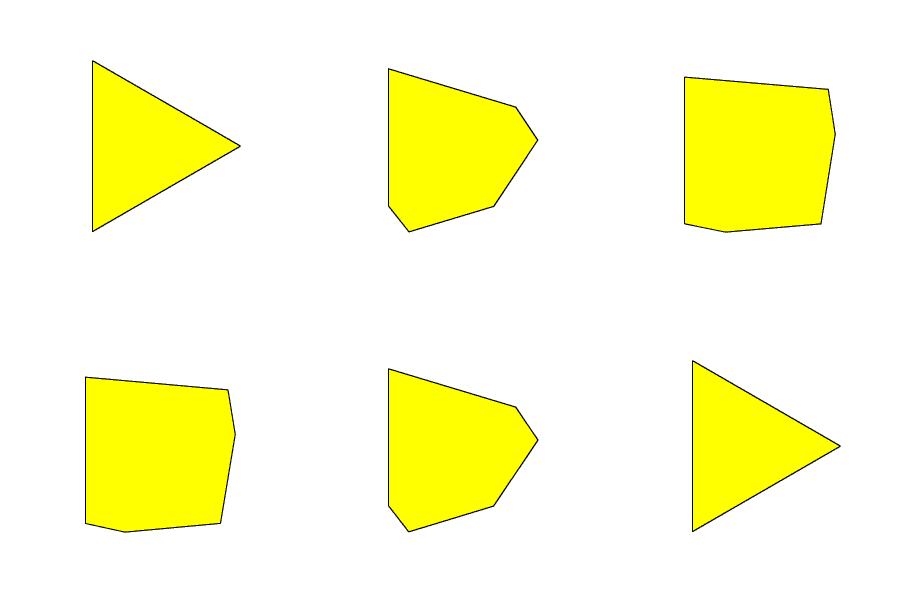
What if the fourth dimension did exist, but nobody could directly affect it or move through it? We might actually be four-dimensional, just like A. Square might actually be a cube in the third dimension, but unaware of it. But we might not be the same at each "cross-section"...
In this example, a 3-dimensional shape has a square at one cross-section and a triangle at another. If something forced it to shift one way or another, it would seem to everyone in Flatland that it was changing shape. At the bottom, there's a sketch for what would happen if it had an infinite number of forms. It would appear as a long rod stretching out to infinity in both directions, and every few inches along the length it might have a different cross-section.
If that were true for people, in the fourth dimension, then it would be possible (by some mysterious force...) to change shape, by shifting through the fourth dimension to a different three-dimensional "cross-section". This could also allow teleportation and invisibility of a sort, as explained before.
Ridiculously improbable, of course, but mathematically possible.
As you probably know, the world we live in already has four dimensions - 0 is time, 1 is forwards-backwards, 2 is left-right, and 3 is up-down. (I'm going to ignore time from now on, since I'm talking specifically about spatial dimensions.)
However, there's been research done on additional dimensions, with string theory saying that there might be nine or more. Obviously we can't see any more dimensions, but people have come up with metaphors for explaining this. One of the most famous is the book "Flatland", narrated by a square living in a supposedly two-dimensional universe. People are polygons, the higher classes having more sides, and buildings are made of several line segments in a pattern.
 |
| A square from Flatland and his house, as seen from above by a three-dimensional observer. |
When a three-dimensional person comes to the narrator's house, he's able to use that additional dimension to move through walls by stepping over them, and can become "invisible" by just being above the world, or somehow seal a door shut by putting a nail through from top to bottom.

|
| This is also how the teleportation works in "A Wrinkle In Time". |
A four-dimensional being would theoretically be able to do the same things in our world as we could in Flatland. However, there are other interesting ways that the fourth dimension could apply.
What if the fourth dimension did exist, but nobody could directly affect it or move through it? We might actually be four-dimensional, just like A. Square might actually be a cube in the third dimension, but unaware of it. But we might not be the same at each "cross-section"...
 |
| This was my original "explanation" for how it might work, using the two-dimensional metaphor. |
 |
| [Click the image if it isn't animating] |
If that were true for people, in the fourth dimension, then it would be possible (by some mysterious force...) to change shape, by shifting through the fourth dimension to a different three-dimensional "cross-section". This could also allow teleportation and invisibility of a sort, as explained before.
Ridiculously improbable, of course, but mathematically possible.
pןɹoʍ oןןǝɥ
Hello everyone!
I just started this blog, so I don't know what my typical posts are going to be like, but I plan to post about interesting things that I do and ideas that I have. Hopefully it will be interesting to read.
If you're wondering about the upside-down title, when I was really young I thought it was interesting to look at writing in different ways, and I taught myself to read and write upside down, mirrored, and reversed. Obviously given the limited alphabet of the English language it's difficult to type upside down, but the International Phonetic Alphabet includes several letters that resemble inverted versions of Roman lowercase letters. For example, the inverted v in the title represents the vowel in the word "cut", the inverted e or schwa is the short vowel in the first syllable of "about", and the inverted r is the English "r" sound (as opposed to a capital R for the French uvular trill, or a normal lowercase r for the Spanish and Italian alveolar trill). When I was trying to think of a good title for the blog, I had an IPA chart open in one of my browser tabs, and I noticed that the letter ʌ closely resembled an inverted v (although it's supposed to be a small A without a crossbar). I saw that several other letters could be "turned" like that, such as using u for n and ı (Turkish dotless i) for i, and I had the idea for the title.
(TL;DR: the title of the blog uses IPA letters to resemble inverted Latin letters.)
Anyway, as you can see, I can sometimes wall-of-text when writing about a topic, and I'll try not to do that too much. I do a lot of science, math, linguistics, and programming stuff, but hopefully my posts won't get too technical.
I hope you find my future writing to be interesting!
I just started this blog, so I don't know what my typical posts are going to be like, but I plan to post about interesting things that I do and ideas that I have. Hopefully it will be interesting to read.
If you're wondering about the upside-down title, when I was really young I thought it was interesting to look at writing in different ways, and I taught myself to read and write upside down, mirrored, and reversed. Obviously given the limited alphabet of the English language it's difficult to type upside down, but the International Phonetic Alphabet includes several letters that resemble inverted versions of Roman lowercase letters. For example, the inverted v in the title represents the vowel in the word "cut", the inverted e or schwa is the short vowel in the first syllable of "about", and the inverted r is the English "r" sound (as opposed to a capital R for the French uvular trill, or a normal lowercase r for the Spanish and Italian alveolar trill). When I was trying to think of a good title for the blog, I had an IPA chart open in one of my browser tabs, and I noticed that the letter ʌ closely resembled an inverted v (although it's supposed to be a small A without a crossbar). I saw that several other letters could be "turned" like that, such as using u for n and ı (Turkish dotless i) for i, and I had the idea for the title.
(TL;DR: the title of the blog uses IPA letters to resemble inverted Latin letters.)
Anyway, as you can see, I can sometimes wall-of-text when writing about a topic, and I'll try not to do that too much. I do a lot of science, math, linguistics, and programming stuff, but hopefully my posts won't get too technical.
I hope you find my future writing to be interesting!
Subscribe to:
Posts (Atom)